Collect every parking fee.
Even when nobody's on site.
A QR code on a sign at the entrance. Drivers scan it, choose how long they're staying (or how much to pay), and pay by card in under a minute. Take payments even when there's nobody on site. You see who has paid and what they paid, and the money reaches your account without anyone having to chase it.
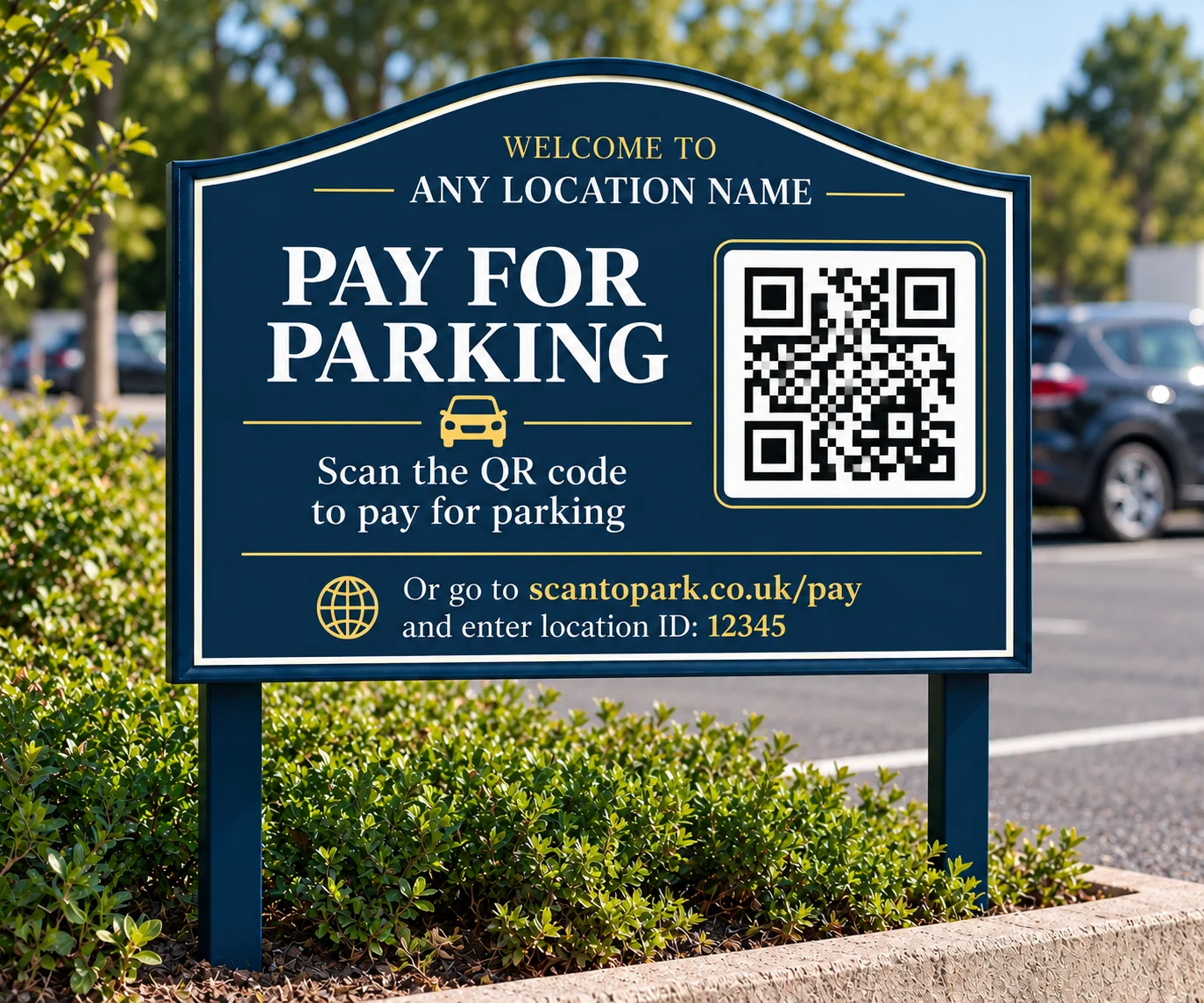
The driver uses their phone camera. There is no app, no account and no sign-up for them.
Register now and start taking payments within 5 minutes. Print your own signage free from your dashboard, or order bespoke signage from us.
Set prices by duration — up to an hour, all day, overnight — or let drivers choose their own amount.
A flat 10% commission on what you collect, with card processing included. Payments made to you weekly.
The parking fees nobody records.
Most car parks already know roughly what happens on a Tuesday morning when nobody's on site and vehicles keep coming in. The question is what to do about it without putting someone on the barrier all week.
- 01Nobody is there to ask
Early mornings, evenings, bank holidays and weekends are exactly when vehicles arrive and there's no one on site.
- 02Collecting it costs someone an evening
Chasing a payment after the fact, writing it up and reconciling it is unpaid admin for income the car park should already have.
- 03You can't see the pattern
Without a record you cannot tell whether your evening rate is working, or whether Thursday is worth staffing.
- 04Chasing payment is awkward
Catching a driver as they're getting back in the car is nobody's idea of a welcome, and it rarely happens.
The sign does the asking. It is polite, it is there every day of the year, and it never has an off week.
Three taps at the entrance.
The whole flow is built for someone standing outdoors, one-handed, on the kind of signal you get in a multi-storey. No login, no app, no account.
Scan
A driver points their phone camera at the sign. The page opens with your car park's name, your logo and today's date — nothing to download.
Choose and pay
Pick how long you're staying — up to an hour, all day, overnight — or enter your own amount if that's how your car park prices. Add your vehicle registration if asked.
Pay and park
Apple Pay, Google Pay or a card. A receipt is sent by email, and the car park's dashboard is updated immediately.
Anywhere Car Park
Wednesday 19 August · 08:42
Under a minute, in the rain.
Built for someone stood at the entrance, phone in one hand, on their way in. Every detail below is there to get them paid and on their way.
-
Duration or donation, your choice
Publish a fixed list of durations, or let drivers enter their own amount subject to a minimum you set. Switch modes any time from your dashboard.
-
Vehicle registration, if you want it
Turn on the registration field and every payment is logged against the plate the driver entered — useful if you patrol the car park.
-
Proof they can show if asked
A short reference code on screen and a receipt by email. If anyone asks, the driver has an answer in their pocket.
-
Closed means closed
Outside your opening hours, or on a closure date, the code shows a polite message and your phone number rather than taking money for parking nobody can use.
Who has paid, and what they paid.
Open it on your phone in the morning and it is all there. No spreadsheet, no reconciliation, no chasing.
Today
One number. Nothing else.
No setup fee, no monthly fee, no minimum. If nobody scans the code, you pay nothing.
- Card processing included. It is covered by our 10%, so your 90% is exactly what it says.
- Weekly payouts straight to the car park's bank account, with a remittance advice sent by email.
- Free short-stay tiers cost nothing to process. A £0 duration option costs you nothing and still appears in your records.
- Unlimited users — site manager, finance, whoever needs the dashboard.
- No setup fee, no monthly fee, no contract length, no exit fee.
Printed entrance signs are available separately, or print your own — the artwork is a free download from your dashboard.
What would that be worth to us?
Move the sliders to your own numbers.
Illustrative only, based on the figures you enter. It assumes every visitor payment goes through the code — the real question for your car park is what share of them does today.
The awkward bits, handled.
Every car park has a rule that doesn't fit the standard form. These are the ones we heard most.
Duration pricing, your way
Publish a flat list of durations — up to an hour, up to four hours, all day, overnight — at whatever prices you set. Reorder them however you like, and drivers pick straight off the list.
Opening hours and closures
Different hours every day of the week, plus closure dates for events, maintenance and Christmas Day. Or leave the code live around the clock if that suits you better.
Let drivers name their own price
Switch to donation mode and drivers choose their own amount, subject to a minimum you set — handy for a car park that runs on goodwill rather than a fixed tariff.
Analytics you'll actually read
Revenue over time, duration mix, average transaction size, and a day-by-hour heatmap that tells you whether Thursday afternoons are worth staffing.
A sign, or just a printout
Order a weatherproof entrance sign printed with your own code, or download the print-ready artwork and put an A4 sheet up this afternoon.
Records your accountant can use
Every order exports to CSV with the fee split shown line by line. Every payout comes with a remittance advice.
Boring, on purpose.
You are letting someone else collect your visitor income. Here is exactly how that works.
Card details never reach us
Payment is handled end to end by a regulated payment provider. Neither we nor your car park ever see a card number, which is also why there is nothing for you to be PCI-compliant about.
Bank details encrypted
Your account number is encrypted the moment you enter it and is never displayed again — only the last four digits, and only to you.
Every penny is accounted for
Each payment writes an entry to an append-only ledger. Your balance is the sum of your own entries, and our costs never touch it. You can trace any payout back to the payments that made it.
Your data stays yours
We hold vehicle registrations (where you ask for them) and email addresses only to issue receipts and show you who paid. Export everything whenever you like, and we delete it on request.
The ones you'll want answered.
What if a visitor doesn't have a smartphone?
They pay the way they do now — at an on-site pay machine, or another way you already offer. The code is there to catch the parking fees you are currently missing, not to replace the ways that already work. Nothing about your existing process has to change.
Is there signal at our entrance?
The page is deliberately small and works on a poor connection, but it does need some. If your entrance is a dead spot, most car parks put the sign further in, near the exit or a payment point instead, where drivers pass anyway. It is worth checking on your phone before you order signage.
How do we know someone actually paid?
Your dashboard shows a live list of who has paid today, with vehicle registrations, times and amounts. The driver gets a reference code on screen and a receipt by email, so if anyone is asked they have it in their pocket. Nobody has to scan anything or carry a device.
Can we still check who's actually parked?
If you turn on vehicle registration, every payment is logged against the plate the driver entered. We don't verify it against the vehicle, so it's self-declared and trust-based — but it gives you a record to check against if you patrol the car park.
When do we get the money?
Weekly, by bank transfer, with a remittance advice you can download and hand to your accountant. There is a small minimum payout threshold; anything under it rolls into the next run rather than disappearing.
What happens if a driver disputes a payment?
You'll see it in your dashboard as soon as it happens, along with what it means for your balance. Chargebacks are rare on transactions like these, and we handle the process on your behalf — but the outcome does affect what you're owed, and the terms set out exactly how.
Who at the car park has to manage it?
In practice, nobody day to day. Prices and opening hours are set once and only change when you change them. Whoever manages the site will want to look at the payout each week — but there is no queue to work through and nothing to reconcile by hand.
How long does it take to set up?
The application takes about ten minutes: car park details, a contact, bank details and the terms. Once it's approved, your code, your opening hours and your base prices are ready to go, and you can print the artwork the same day.
Put a sign on the entrance.
Ten minutes to apply. Nothing to pay until a driver pays you.